Last updated: 23 September 2026
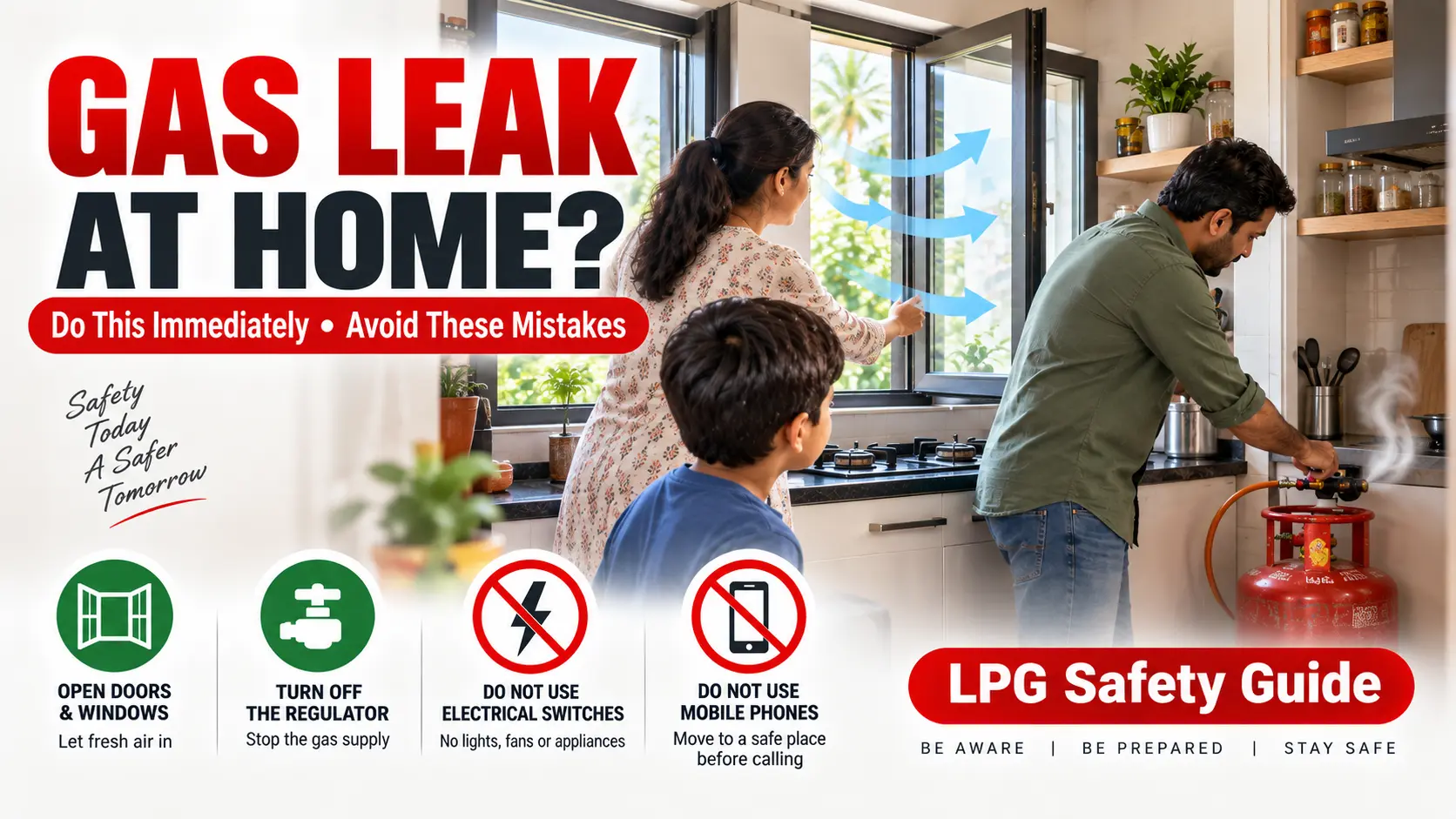
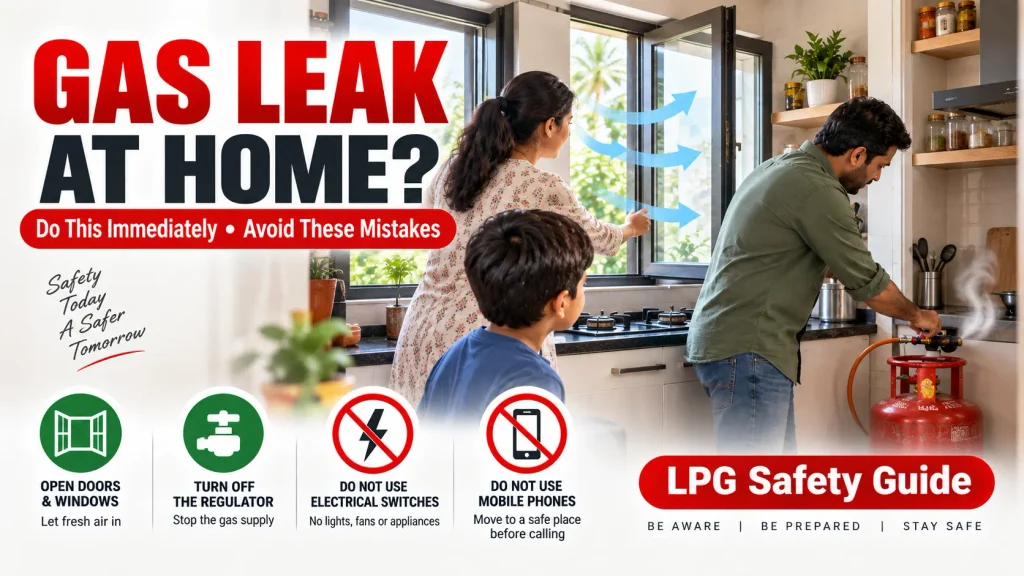
If you can smell gas right now, stop reading and do this first: turn the regulator knob to OFF, don’t touch any electrical switch, open the doors and windows, get everyone out, and call 1906 from outside the house.
Everything below explains why each of those steps matters, what not to do, and what happens after you call. It’s worth reading once on a calm day, so that on the day it actually happens, you don’t have to think.
How to Tell If It’s Really a Leak
LPG itself has no smell. The gas companies add a strong-smelling chemical to it on purpose, so that a leak is impossible to miss. Most people describe it as rotten eggs or rotten cabbage.
The usual signs:
- That smell, especially near the floor of the kitchen, or when you first walk into a closed room in the morning
- A hissing sound near the cylinder, regulator or pipe
- A cylinder emptying much faster than usual, with no change in how much you cook
- A flame that burns yellow or orange instead of blue — not always a leak, but worth checking
A faint smell for a second when you light the burner is normal; that’s the gas that came out before the flame caught. A smell that stays, or that is there when nothing is switched on, is not.
What to Do, Step by Step
1. Turn off the gas
Turn the regulator knob to the OFF position. If you can reach it safely, also check that every burner knob on the stove is closed. This stops more gas coming out, and on its own often solves a small leak.
2. Put out every flame
Burners, diyas, candles, agarbattis, a mosquito coil in the next room — all of them. Gas travels further than you think.
3. Do not touch any electrical switch
This is the step people get wrong most often, because the instinct is to switch on the light to see better, or switch on the exhaust fan to clear the air.
Don’t. Flipping a switch — on or off — can produce a tiny spark inside it, and a tiny spark is all it takes. The same goes for plugging or unplugging anything, ringing an electric doorbell, or starting the inverter. If a light is already on, leave it on. If it’s off, leave it off.
4. Open doors and windows
Open everything you can, by hand. LPG is heavier than air, so it settles low — along the floor, under the kitchen platform, in corners. Opening the main door and any low windows helps it flow out. Don’t wave cloths around or try to push the gas out; just let air move through.
5. Get everyone out
Children, elderly family members, pets. If the smell is strong, don’t stop to collect things.
6. Call 1906 — from outside
Make the call once you’re out of the house. A mobile phone is an electrical device; using it in a room full of gas is an avoidable risk.
What NOT to Do
Some of these sound obvious. Every one of them has caused real accidents in Indian homes.
- Never use a match, lighter or flame to find the leak. Not even “just to check quickly”.
- Don’t switch on the exhaust fan or chimney. Same spark risk as any switch.
- Don’t drag the cylinder outside if it is leaking from the valve. Moving it can make the leak worse, and the metal scraping on the floor can cause sparks.
- Don’t try to repair the regulator, valve or pipe yourself. Tightening it with a spanner or wrapping tape around it is not a fix.
- Don’t go back in to see whether the smell has gone. Wait for the mechanic.
What Happens When You Call 1906
1906 is the national LPG emergency helpline. It is free, it works 24 hours a day, and it handles all three companies — Indane, HP Gas and Bharat Gas. You don’t need to know which one you’re with; they will find out from your details.
The service is available in Hindi, English and several regional languages.
When you call:
- An executive takes down your name, address, registered mobile number and what you’re noticing.
- They give you immediate safety instructions — mostly the steps above.
- Your complaint is logged and passed to your distributor, who sends a mechanic to your registered address.
- The complaint is tracked until the mechanic confirms it is fixed, and you may get a follow-up call.
Keep your consumer number handy if you can, but don’t delay the call looking for it. Your mobile number and address are enough to begin.
If the call doesn’t connect
During peak times, getting through can take a while. If you can’t get through within a few minutes, call your distributor’s number directly — it’s printed on your cash memo. It helps to save it in your phone today, under a name you’ll find quickly, like “Gas Agency”.
If there is a fire
Don’t try to fight a cylinder fire yourself. Get everyone out, keep people away from the house, and call the fire service on 101 or the emergency number 112. Then call 1906.
Why Leaks Happen in the First Place
Almost every household leak comes from one of four places:
- The rubber pipe. Pipes harden and crack over time, especially where they bend near the stove. This is the single most common cause.
- The washer inside the cylinder valve. A small rubber ring called the O-ring seals the connection between cylinder and regulator. If it’s torn or missing, gas escapes as soon as the regulator is fitted.
- The regulator. A worn or damaged regulator, or one that isn’t locked on properly.
- The stove knobs. A knob left half-open, or a worn valve inside the stove itself.
A Simple Test You Can Do on a Normal Day
If there’s a faint smell you can’t place — not a strong one — you can check the joints with soapy water:
- Mix a little dishwashing liquid or soap with water.
- With the regulator ON and all burners OFF, brush or dab the solution on the joints: where the regulator meets the cylinder, both ends of the pipe, and where the pipe connects to the stove.
- Watch for bubbles. Bubbles growing at any point mean gas is escaping there.
- If you see bubbles, turn the regulator OFF and call for a mechanic.
Only do this for a faint, uncertain smell. If the smell is strong, skip the test and follow the emergency steps at the top.
Habits That Prevent Most Leaks
- Turn the regulator off at night and whenever you leave home for more than a few hours.
- When a new cylinder is delivered, ask the delivery person to check the O-ring before fitting the regulator. It takes ten seconds.
- Keep the cylinder upright, on the floor, never inside a closed cabinet.
- Keep the pipe short, clear of the burner flame, and away from the back of the hot stove.
- Look at the pipe every few months. If it’s cracked, hard, or sticky, replace it.
- Only buy the regulator and pipe from your distributor, not the local market.
Quick Answers
Is 1906 free?
Yes, the call is free and the line runs 24×7.
Does 1906 work for HP Gas and Bharat Gas too?
Yes, it covers all three companies.
Can I cook once the mechanic leaves?
Yes, once they have fixed the fault and confirmed there’s no more leak. Air the kitchen out first.
The smell comes and goes. Should I still call?
Yes. An intermittent smell usually means a small leak that gets worse over time, not better.
I live alone and I’m not sure if it’s a leak. What should I do?
Turn the regulator off, open the windows, and call. The helpline would much rather check a false alarm than miss a real one.
Stay Safe
Regulator off, no switches, windows open, everyone out, call 1906 from outside. Those five things, in that order, are the whole emergency response. The rest of this page is just the reasons.
Save 1906 and your distributor’s number in your phone today, and show this page to whoever else in your home uses the kitchen. It’s the kind of thing everyone should know before they need it.