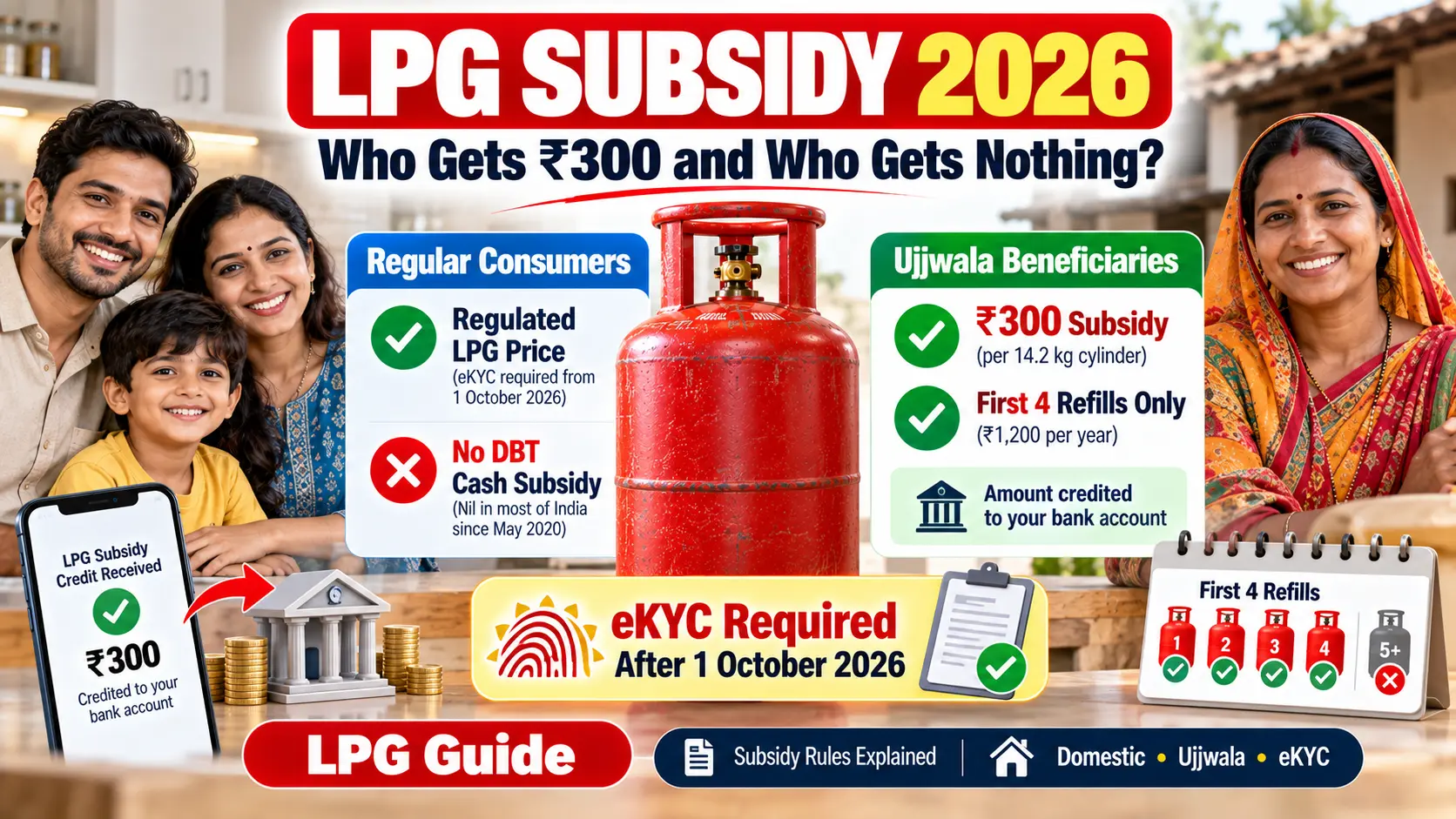
Ask ten people how much LPG subsidy they get and you’ll hear ten different answers. Some say ₹300. Some say nothing has come for years. Someone’s uncle insists it’s ₹200 and arrives in the bank account a week after the cylinder.
Most of them are partly right, because in 2026 “LPG subsidy” means three separate things, and each one works differently. Once you know which of the three applies to you, the amount stops being a mystery.
The Three Kinds of LPG Subsidy
| Type | Who gets it | How much | How it reaches you |
|---|---|---|---|
| Regulated price | Domestic consumers who have completed eKYC | Changes monthly; about ₹210 per cylinder in September 2026 | Built into the price you pay at the door |
| DBT cash subsidy | General domestic consumers | Nil in most of India since May 2020 | Bank account |
| Ujjwala targeted subsidy | PMUY beneficiaries only | ₹300 per cylinder, first 4 refills a year | Bank account |
Let’s go through each one.
Do Read – Today LPG gas Cost by Indian Govt (Official List)
1. The Subsidy Hidden Inside the Price

This is the one almost nobody counts, and it’s actually the biggest.
The ₹942 you pay for a 14.2 kg cylinder in Delhi is not what that gas really costs. It’s a regulated retail price, and the oil companies absorb the difference between that and the actual cost. The government calls this the implicit subsidy, or under-recovery.
How big is the gap? It moves every month with international prices. The government put it at around ₹210 per cylinder in September 2026. In July it was more than ₹500. In June, when global prices were at their worst, an official said the cylinder “should have cost ₹1,600”.
You never see this money in your bank. You see it as a price that stayed at ₹942 while commercial cylinders swung by a thousand rupees.
What changes on 1 October 2026
Until now, everyone with a domestic connection got this regulated price automatically. From 1 October, it goes only to consumers who have completed biometric Aadhaar authentication, usually called eKYC.
If you haven’t done it, you still get your cylinder, but at the market price, which will be higher than the regulated one by roughly that month’s implicit subsidy. Around 90 per cent of consumers had already completed eKYC by 19 September. If you’re not sure whether you’re one of them, check the status in your gas company’s app. It takes a minute.
2. The DBT Cash Subsidy
This is the one people remember: the small credit that used to land in the bank account after each refill, under the PAHAL scheme.
For a general domestic consumer today, that amount is zero in most of the country, and has been since May 2020. Delhi and most large cities have seen no DBT subsidy on domestic refills since then. A few remote and hard-to-reach areas have continued to see a small credit, but it’s minor.
So if you’re a general consumer and nothing is coming into your account after a refill, that’s almost certainly not a fault. It’s the scheme working as it currently stands.
That said, keeping your Aadhaar and bank account linked is still worth it. The DBT channel is how the Ujjwala subsidy travels, and it’s how any future subsidy would reach you if rates are revised.
3. The Ujjwala Targeted Subsidy
This one applies only if your connection was issued under the Pradhan Mantri Ujjwala Yojana (PMUY).
- Amount: ₹300 per 14.2 kg cylinder, credited to your bank account
- How many cylinders: the first four refills in a financial year
- Maximum per year: ₹1,200
The four-refill limit is new. Until June 2026, the ₹300 applied to up to nine refills a year. On 8 June 2026 the government cut that to four, citing data that Ujjwala households used about 4.7 cylinders a year on average in 2025-26.
Nothing stops you from buying more than four cylinders. From the fifth refill onwards, you simply pay without the ₹300 top-up, though you still get the regulated price like every other domestic consumer who has done eKYC.
Ujjwala beneficiaries using the smaller 5 kg cylinder get proportionate support rather than the full ₹300. Your distributor can tell you the exact figure.
Which Subsidy Do You Get? A Quick Check
Answer these in order:
- Is your connection domestic? If it’s commercial, no subsidy of any kind applies.
- Have you completed eKYC? If yes, you get the regulated price from 1 October. If no, you’ll pay market price until you do.
- Was your connection issued under Ujjwala? If yes, you also get ₹300 in your bank on your first four refills of the year. If no, skip to the next step.
- General consumer? Expect nothing in your bank account after a refill. Your benefit is the regulated price itself.
Not sure whether your connection is an Ujjwala one? Your subscription voucher or your gas company’s app will say. If you received your connection free, with a stove and first refill included, it’s very likely PMUY.
Who Is Not Eligible
A few situations take you out of some or all of the above.
Household taxable income above ₹10 lakh
Since 2016, a consumer whose taxable income, or whose spouse’s taxable income, is above ₹10 lakh a year has not been entitled to the LPG cash subsidy. Given the DBT amount is nil for general consumers anyway, this rarely makes a practical difference today.
You gave up your subsidy
Under the “Give It Up” campaign, millions of households voluntarily surrendered their subsidy. If you did this years ago and forgot, it still applies to your connection.
No eKYC after 1 October
As covered above, you lose the regulated price until you complete it.
Two domestic connections in one household
One household is meant to have one domestic connection. A second connection at the same address can be flagged as duplicate, and duplicates are exactly what eKYC is designed to catch.
Commercial use
Domestic cylinders used in a shop, dhaba or any business don’t qualify for anything, and using them that way is illegal in the first place.
How It Shows Up on Your Bill and in Your Bank
On the cash memo: the regulated price. For an eKYC-complete consumer in Delhi that’s ₹942 right now. If you ever see a noticeably higher figure after 1 October, check your eKYC status first.
In your bank account: only the Ujjwala ₹300, if it applies, and only for the first four refills of the financial year. It arrives some days after delivery, not at the door.
If you’re an Ujjwala beneficiary and the ₹300 hasn’t come for a refill within the first four, that’s a problem worth chasing, and the reasons are usually Aadhaar-bank linking, KYC, or a name mismatch.
Quick Answers
I’m a general consumer. Why do I get nothing in my bank after a refill?
Because the DBT subsidy for general consumers has been nil in most places since May 2020. Your benefit is the regulated price you pay at the door.
Is the Ujjwala subsidy still ₹300?
Yes, ₹300 per 14.2 kg cylinder, but now only on the first four refills of each financial year.
When does the four-refill count reset?
With the financial year, on 1 April.
Can I get more than four subsidised cylinders if I have a big family?
Not under the current rule. You can buy as many as you need, but only four carry the ₹300.
How can I see the exact amount credited to me?
Check your subsidy status on the official portal with your 17-digit LPG ID, and match it against your bank statement.
The Takeaway
For most households, the real subsidy today isn’t a bank credit at all. It’s the regulated price, and from 1 October you keep it only by completing eKYC. Ujjwala families get ₹300 more on top, but on four cylinders a year now, not nine.
Rules on this have changed twice in 2026 already, so the date at the top of this page matters. Scheme details and eKYC guidance are also on the official PMUY portal. And if what’s reaching your account doesn’t match anything described here, tell us what you’re seeing.

Pratham Shetty is an SEO Expert for Websites , Blogs and Apps and has been working in this field since 2020 . He has developed many Blogs and apps and one of the LPG gas booking apps crossed 25k+ Organic downloads in few Months . You can Search LPG Gas Boooking app by Classic Avenue and enjoy the app.
1 thought on “How Much LPG Subsidy Do You Actually Get in 2026”