Every family has a version of this story. It’s Sunday morning, the pressure cooker is on its second whistle, and the flame suddenly dies. The cylinder is empty. You can’t book a refill for another few days, the delivery will take a few more after that, and the next week is spent borrowing a neighbour’s stove or living on Maggi from the induction plate.
Now think of the family next door that never seems to have this problem. Their secret isn’t luck. They have two cylinders. When one runs out, they switch the regulator to the spare, book a refill, and carry on cooking.
That second cylinder comes from a Double Bottle Connection (DBC), also called a double cylinder connection. This guide explains what it is, who should get one, what it costs, how to apply, and an important point about the 2026 supply situation that you should know before you go to your distributor.
Do Read – LPG Connection Blocked? Why It Happens
What Is a Double Cylinder Connection?
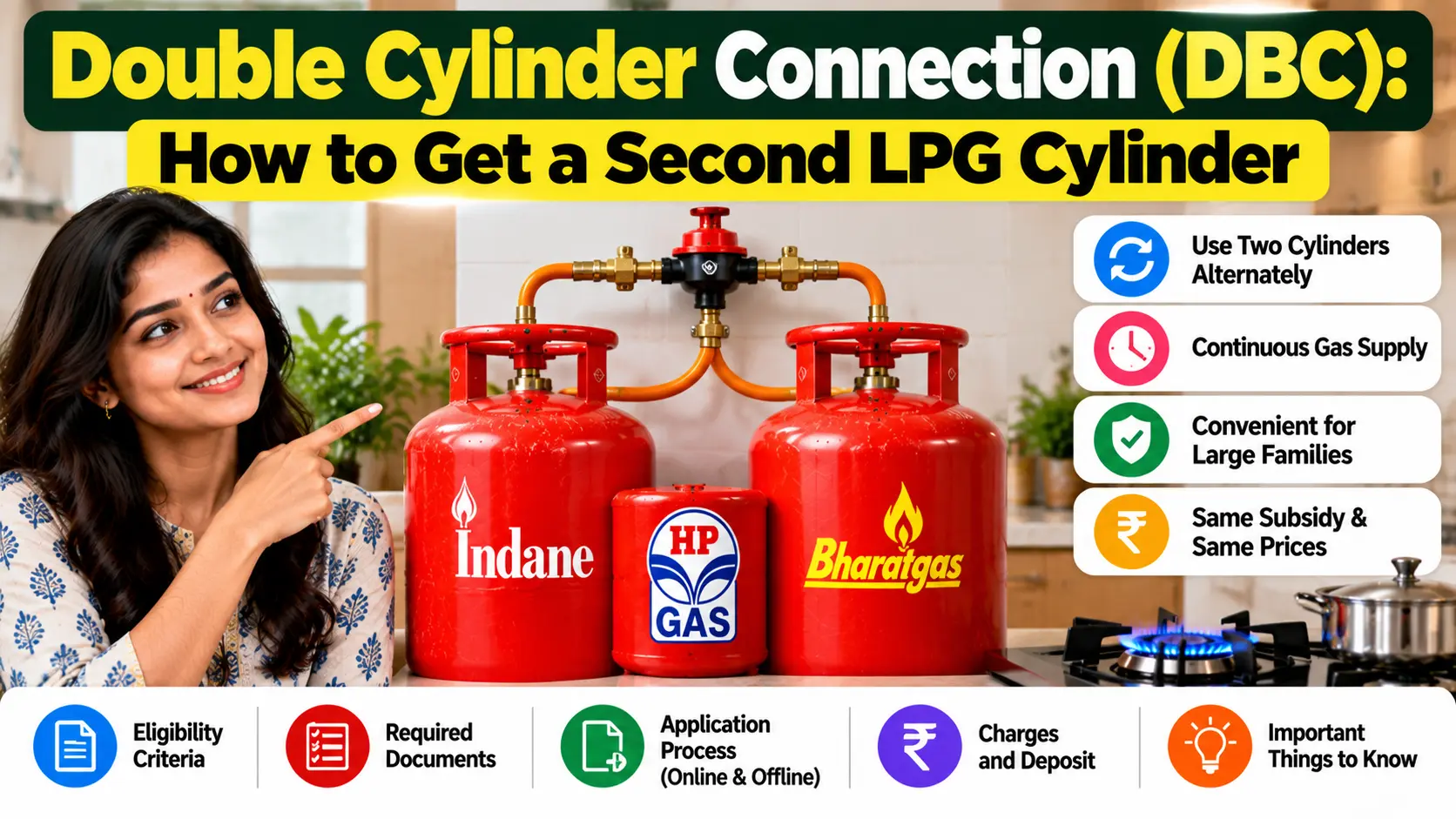
A DBC simply means two cylinders on your existing connection, instead of one. IndianOil’s Citizen’s Charter calls it an “Additional Cylinder (Double Bottle Connection)”.
- Same connection, same consumer number. It isn’t a second connection. It’s a second cylinder on the connection you already have.
- One in use, one in reserve. One cylinder is connected to your stove, and the other stands by, full and sealed.
- One regulator is enough. When the first cylinder empties, you move the regulator to the spare.
- One booking at a time. You book a refill for the empty cylinder while you cook on the full one.
One thing to be clear about: the rule is one household, one connection. If you want two cylinders, a DBC is the right way to get them. Taking a second connection in another family member’s name is not, and duplicate connections are actively being found and blocked.
Before You Apply: The 2026 Situation
Here’s something most DBC guides won’t tell you. Because of the LPG supply crunch caused by the West Asia conflict, getting a second cylinder hasn’t been as simple in 2026 as it used to be.
- New connections were put on hold. According to news reports, no new 14.2 kg domestic connections have been issued since March 2026, and they were still on hold in mid-October. The petroleum ministry has called this a temporary measure.
- Second cylinders were stopped in some places too. In Kolkata, for example, the oil companies stopped issuing second cylinders “until further notice” in March 2026. An official said new connections and second-cylinder requests would resume in phases once supply normalises.
- The normal promise comes with conditions. IndianOil’s charter says it will try to release a new connection or an additional cylinder within seven working days, but subject to circumstances beyond its control, including supply constraints and government directives.
What this means for you: before you plan your budget, call your distributor and ask one simple question: “Are you releasing second cylinders right now?” If they are, read on. If not, the alternatives at the end of this guide will help in the meantime.
Do Read – PNG Gas Leak: What to Do Immediately, Emergency Numbers
Who Should Get a Second Cylinder
A DBC is worth it if any of these sound like your home:
- A big or joint family that goes through a cylinder every three or four weeks.
- Elderly parents at home, who shouldn’t be left without gas while a refill is on its way.
- Slow deliveries in your area, common in rural areas, hilly places and during festival rushes.
- Nobody at home during the day, so deliveries often get delayed or rescheduled.
- A small food business run from home? Careful here. Domestic cylinders are only for household cooking. For any business, use a commercial cylinder.
Who may not need one
- One or two people whose single cylinder lasts two months or more.
- Homes with very little space, where a second cylinder can’t be kept safely.
- Homes that are switching to piped gas. A household with PNG can’t keep an LPG connection at all, so a DBC makes no sense there.
How a Second Cylinder Actually Helps
A second cylinder doesn’t give you more gas in a year, and it doesn’t let you book more often. Since 7 September 2026, all domestic consumers have to keep a gap of 25 days between bookings, whether they have one cylinder or two.
What it does give you is time. Here’s how it works in practice:
- Cylinder A runs out. You move the regulator to cylinder B and keep cooking.
- You book a refill straight away, as long as 25 days have passed since your last booking.
- The delivery person brings a full cylinder and takes the empty one.
- The new full cylinder becomes your spare, and the cycle repeats.
So even if a delivery takes a week, which is within IndianOil’s normal standard of seven working days, your kitchen never stops.
Who Can Apply
You can usually get an additional cylinder if:
- You have an active domestic LPG connection, and the request comes from the connection holder.
- Your household has only this one connection, with no second connection in any family member’s name.
- Your household doesn’t have a PNG connection. Since March 2026, households with PNG can’t hold a domestic LPG connection.
- Your KYC is in order and your eKYC is complete. From 1 October 2026, booking at the subsidised rate needs biometric Aadhaar authentication anyway.
- You live in your distributor’s service area, at the address on your connection.
The oil companies also run de-duplication checks before releasing a new connection or an extra cylinder, so your details need to match across your records.
If yours is an Ujjwala (PMUY) connection, ask your distributor whether a second cylinder can be added, and on what terms, before you apply.
Do Read – PNG Bill: How to Check, Read and Pay Your Piped Gas Bill Online
What It Costs
| Item | Amount | Refundable? |
|---|---|---|
| Security deposit for the second cylinder | ₹2,200 in most of India (₹2,000 in the North-Eastern states) | Yes, when you surrender |
| Gas in the second cylinder | The current refill price, such as ₹942 in Delhi | No, you’re paying for the gas |
| Regulator | Not needed. One regulator works for both cylinders. | Not applicable |
| Approved service charges, if any | Ask your distributor | Depends on the charge |
So in Delhi, a second cylinder costs roughly ₹3,142 upfront, plus any small approved service charges. Most of that, the ₹2,200 deposit, comes back to you when you surrender the connection.
A few points to remember:
- Pay only approved charges. IndianOil, for example, says its approved security deposit, tariff and service charges are listed on its customer portal.
- Get a receipt for every rupee. A deposit without a receipt is a deposit you can’t claim back.
- Refills cost the same. Each refill is charged at the normal price. Having two cylinders doesn’t change the price per cylinder, or any subsidy you’re entitled to.
- Say no to forced purchases. Nobody can make a second cylinder conditional on you buying a stove, lighter or “safety kit”. That’s listed as an irregularity in the oil companies’ rules for distributors.
How to Apply for a Second Cylinder
Online
IndianOil’s charter says consumers can apply for an additional cylinder either online or at the distributor. Look for an option like “Additional cylinder” or “DBC” in your company’s app or on its website:
- Indane: the IndianOil ONE app or IndianOil’s customer portal
- HP Gas: the HP Pay app or myhpgas.in
- Bharat Gas: the Hello BPCL app or my.ebharatgas.com
If you can’t find the option, don’t worry. Apply at the distributor instead.
At your distributor
- Visit the distributor’s office, ideally with the connection holder.
- Ask for the additional cylinder (DBC) form, and fill it in.
- Show your documents (see the checklist below).
- Pay the security deposit and the cost of the gas, and collect the receipt.
- Collect the voucher or updated paperwork for the second cylinder.
- Take delivery of the cylinder, either at the office or at home, as the distributor arranges.
A shortcut for HP Gas customers
HP Gas delivery staff use an app called Vitaran, which HP says can handle requests for a double bottle connection, along with bookings and KYC updates. So you can also ask the delivery person when your next refill arrives.
Documents Checklist
- The connection holder’s Aadhaar card
- Your consumer number, from a recent cash memo or your consumer card
- Your Subscription Voucher (SV)
- Your registered mobile phone, for OTPs
- Address proof, if your address has changed since you took the connection
- Money for the deposit and the gas, and a way to get a receipt
Look after the new paperwork
Your Subscription Voucher records the cylinders given to you against your deposit. After a DBC, your paperwork should show two cylinders, either on an updated SV or on a separate voucher for the second one. Keep it with your original SV. When you surrender the connection one day, it’s what gets you both deposits back.
Using Two Cylinders the Smart Way
- Book the moment you switch. Don’t wait for the second cylinder to run low.
- Write down your booking dates. A note on the fridge or in your phone tells you when the 25-day gap ends.
- Check every cylinder at delivery. Look at the seal and the test due date on the collar, and make sure there’s no smell of gas before you share your delivery code.
- Use the older cylinder first, so the spare doesn’t sit unused for months.
- Teach everyone at home how to switch the regulator safely, so nobody waits for you to come home.
Keeping a Spare Cylinder Safely at Home
A full cylinder standing in your kitchen deserves a little respect. LPG is heavier than air, so if it ever leaks, it sinks and collects low down, in corners and inside cupboards.
- Keep it upright, on the floor. Never lay it on its side.
- Never inside a closed cabinet. Leaked gas can collect there unnoticed.
- Keep the safety cap on the valve of the spare cylinder.
- Keep it away from heat, like the stove, the oven or direct sunlight.
- Choose a ventilated spot in the kitchen. Not the bedroom, not the bathroom.
- If you ever smell gas, don’t touch any switch or flame, open the windows, and call the LPG emergency number, 1906.
When You Move or Surrender
- Moving within the same city: the transfer covers both cylinders. You carry both to your new home.
- Moving to another city: you surrender both cylinders and the regulator, and get a Termination Voucher to reconnect at the new place.
- Closing the connection: the deposit for each cylinder is refunded, as written on your paperwork. If it’s an old connection, remember that the refund is the deposit you actually paid, not today’s rate.
- Switching to piped gas: apply to close your LPG connection within 30 days of getting PNG, and return both cylinders.
If You Can’t Get a Second Cylinder Right Now
If your distributor isn’t releasing second cylinders at the moment, you still have options:
- A 5 kg FTL cylinder. Indane’s Chhotu, HP Gas Appu and Bharat Gas Mini need only an ID proof to buy, and there’s no booking gap. The gas costs more per kilo, but as an emergency backup it works well.
- A 10 kg composite cylinder, which the oil companies offer in some cities, at the market price.
- Piped gas, if the pipeline already reaches your building. It ends the booking problem for good, though it means giving up your LPG connection.
- Better timing. Book as soon as the 25-day gap ends, rather than waiting for the flame to die.
Beware of “Extra Cylinder” Offers
When supply is tight, people start offering cylinders on the side. Stay away:
- A cylinder bought without papers isn’t registered to you, so there’s no deposit to claim back and no record if something goes wrong.
- It may be overdue for testing, underweight or not properly sealed.
- LPG accident insurance covers authorised connections at the registered address, not cylinders bought from strangers.
Always get your second cylinder through your own distributor, with a receipt.
Do Read – PNG Price Today: City-Wise Domestic PNG Rate per SCM
Quick Answers
What is a DBC in LPG?
A Double Bottle Connection: a second cylinder on your existing LPG connection, so you always have a spare.
How much does a second gas cylinder cost?
A refundable security deposit of ₹2,200 in most of India, plus the price of the gas in it. In Delhi, that’s about ₹3,142, plus any approved service charges.
Can I book refills more often with two cylinders?
No. The 25-day gap between bookings still applies. The second cylinder just means you’re never without gas while you wait.
Can I get a second connection instead of a second cylinder?
Not for the same household. The rule is one household, one connection. A DBC is the proper way to have two cylinders.
Are second cylinders being issued right now?
It depends on your area. In 2026, supply problems led to new connections being put on hold, and in some places second cylinders too. Ask your distributor.
Do I get the deposit back?
Yes. The deposit for each cylinder is refunded when you surrender the connection, so keep the paperwork safe.
One in Use, One in Reserve
A second cylinder is one of the simplest upgrades a household can make. For about the price of three refills, most of which you get back one day, it takes the panic out of running out of gas. Check with your distributor whether second cylinders are being released in your area, apply with the right documents, keep your receipts, and store the spare safely. After that, an empty cylinder on a Sunday morning becomes a two-minute job instead of a week-long problem.
IndianOil sets out its standards for releasing an additional cylinder in its Citizen’s Charter. If your distributor asked for something different, or second cylinders have started again in your area, tell us, and we’ll update this guide.

Pratham Shetty is an SEO Expert for Websites , Blogs and Apps and has been working in this field since 2020 . He has developed many Blogs and apps and one of the LPG gas booking apps crossed 25k+ Organic downloads in few Months . You can Search LPG Gas Boooking app by Classic Avenue and enjoy the app.
1 thought on “Double Cylinder Connection (DBC): How to Get a Second LPG Cylinder”