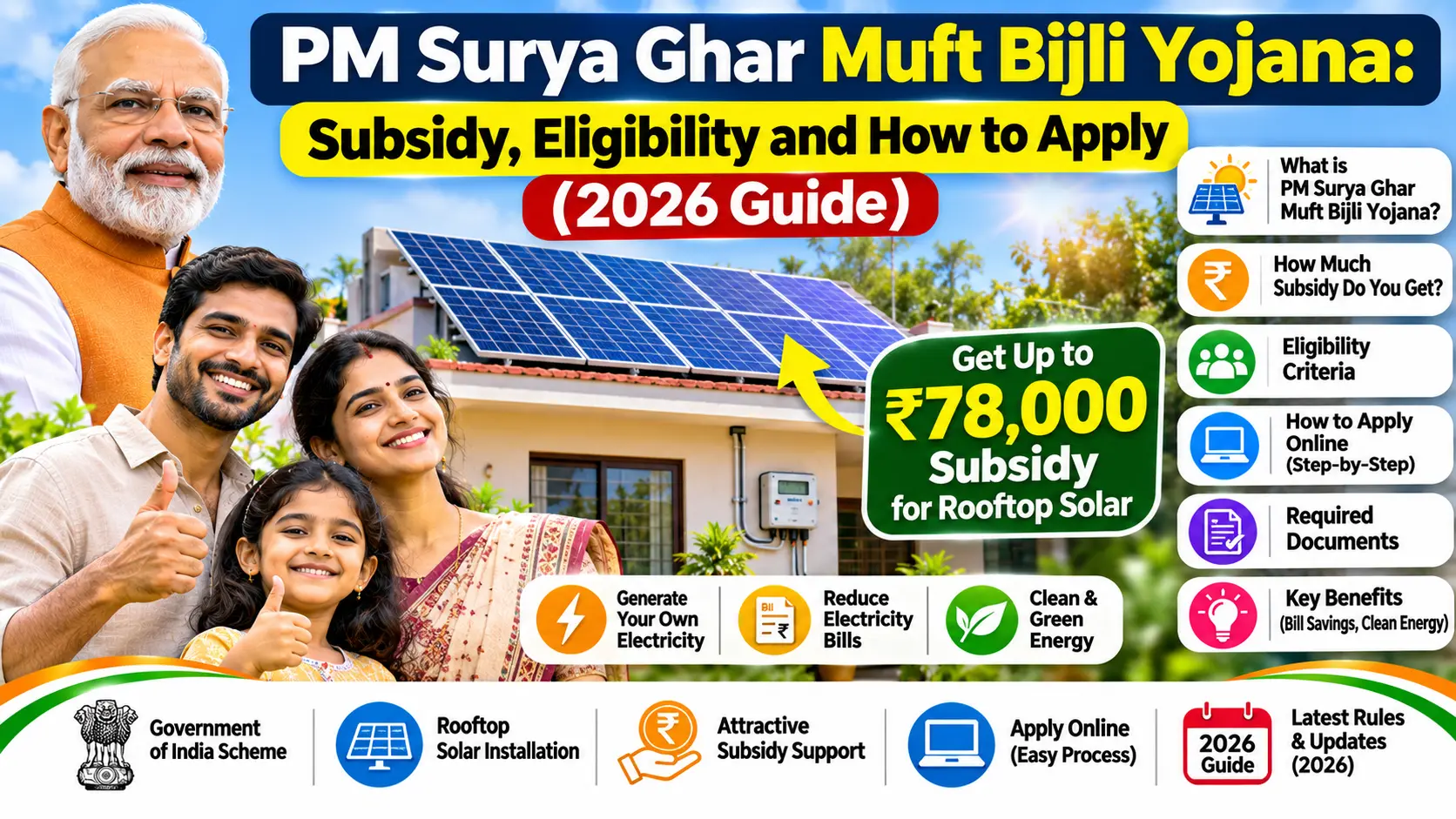
Quick answer: PM Surya Ghar: Muft Bijli Yojana pays part of the cost of putting solar panels on your roof: ₹30,000 per kW for the first 2 kW and ₹18,000 for the third, so up to ₹78,000. You apply on the national portal, get the system installed by a registered vendor, and once your discom inspects it, the subsidy goes straight into your bank account.
Every May, the same scene plays out in lakhs of homes. The cooler runs all day, the fridge works overtime, and the electricity bill lands on the table with a number nobody wants to say out loud. Meanwhile, on the roof, the same harsh sun that makes the cooler necessary falls on bare concrete, doing nothing for anyone.
Then a neighbour puts up solar panels, and a few months later he’s showing everyone a bill of almost zero. Suddenly the whole lane has questions. Is the bijli really muft? How much do we have to pay first? Is there a catch? This guide answers all of it: what the scheme gives you, who can apply, what it really costs, how to apply step by step, and the mistakes that can cost you the subsidy.
Do Read – Today’s LPG Gas Cylinder Price in India — State and City Wise
What “Muft Bijli” Actually Means
Let’s clear up the biggest confusion first. The government doesn’t send you 300 free units every month. What it does is pay a large part of the cost of solar panels on your roof. Those panels then produce electricity for free, for years.
The government describes the scheme as giving households up to 300 units of free or low-cost electricity a month. In practice, how much you get depends on how big your system is, how much sun your roof gets, and how much electricity you use.
The scheme at a glance
- Approved: by the Union Cabinet on 29 February 2024
- Total outlay: ₹75,021 crore
- Target: rooftop solar in one crore households by 2026-27
- Progress: more than 50 lakh households had rooftop solar under the scheme by early August 2026, and July 2026 saw a record 5.06 lakh new installations in a single month
- Subsidy paid by August 2026: ₹28,024 crore, credited directly to beneficiaries’ bank accounts
How Much Subsidy You Get
The subsidy is officially called Central Financial Assistance (CFA). Under MNRE’s guidelines, it works like this:
| System size | Subsidy (most states) | Subsidy (special category states) |
|---|---|---|
| 1 kW | ₹30,000 | ₹33,000 |
| 2 kW | ₹60,000 | ₹66,000 |
| 3 kW | ₹78,000 | ₹85,800 |
| Above 3 kW | ₹78,000 (no extra subsidy) | ₹85,800 (no extra subsidy) |
In other words, you get ₹30,000 per kW for the first 2 kW and ₹18,000 for the third kW. Beyond 3 kW, you can install a bigger system if you like, but the subsidy stays the same.
Do Read : 5 kg Gas Cylinder (Chhotu) Price and How to Buy One Without Address Proof
Special category states and UTs
Households in these places get a higher rate of ₹33,000 per kW for the first 2 kW and ₹19,800 for the third:
- The North-Eastern states, including Sikkim
- Uttarakhand and Himachal Pradesh
- Jammu & Kashmir and Ladakh
- Andaman & Nicobar Islands and Lakshadweep
Your state may add more
MNRE’s amended guidelines allow state governments to add their own subsidy on top of the central one. A few states do, so ask your discom or a registered vendor whether there’s a state top-up where you live.
How Much Solar Does Your Home Need?
Start with your electricity bills, not with the subsidy. Look at how many units you used each month over the last year, and work out the average.
Installers often work with a rough planning figure of about 120 units a month for every 1 kW of panels. The real figure varies with your city’s sunlight, the weather, the season and any shade on the roof, but it’s a good starting point:
| Your average monthly use | System that may suit you | Central subsidy |
|---|---|---|
| Up to about 120 units | 1 kW | ₹30,000 |
| About 120 to 240 units | 2 kW | ₹60,000 |
| About 240 to 360 units | 3 kW | ₹78,000 |
Check your roof too
- Space: installers usually plan for roughly 100 square feet of shade-free roof for every kW.
- Shade: a water tank, a taller building next door or a big tree can cut your output. Ask the vendor to check shade at different times of day.
- Strength: the roof must safely carry the panels and their mounting structure.
Who Can Apply
The scheme’s eligibility conditions are simple:
- You’re a citizen of India.
- You own a house with a roof suitable for solar panels.
- You have a valid electricity connection, and it’s a residential connection.
- You haven’t already taken any other subsidy for solar panels.
If you live on rent, the scheme is meant for the person who owns the house and the roof, so the owner would need to apply.
When you won’t get the subsidy
MNRE’s guidelines rule out a few cases, so check these before you spend anything:
- Non-residential connections, such as a shop or office connection.
- Off-grid systems that aren’t connected to the discom’s network.
- Panels that aren’t made in India. Only modules made in India, using solar cells made in India, qualify. The guidelines say that using non-DCR (domestic content requirement) modules in any form makes the installation ineligible.
- A second subsidy. A system gets the subsidy only once, and systems moved from another place aren’t eligible.
- Leased or rented systems. The residential subsidy covers systems you buy yourself.
Living in a Flat? Your Society Can Apply
In a multi-storey building, individual flats usually don’t have their own roof. That’s why the scheme has a separate route for Group Housing Societies and Resident Welfare Associations (RWAs):
- The subsidy is ₹18,000 per kW (₹19,800 in special category states).
- It’s for common facilities, such as common area lighting and EV charging.
- It covers up to 500 kW, at up to 3 kW per house, and that limit includes any individual rooftop plants in the society.
If your society’s common electricity bill is high, raise this at the next RWA meeting. Lower common charges help every resident.
Do Read : LPG Cylinder Price History: Every Change in the Last 5 Years
What It Will Actually Cost You
The subsidy doesn’t cover the whole system, so you’ll need to pay the rest yourself, or through a loan.
- The government’s benchmark: MNRE works out the subsidy using a benchmark cost of ₹50,000 per kW for the first 2 kW and ₹45,000 per kW after that (₹55,000 and ₹49,500 in special category states).
- Real-world quotes are often higher. Prices depend on the brand, the inverter, the height of the mounting structure and your city. Prices published by one large installer in September 2026, for example, were about ₹1.2 to 1.3 lakh for 1 kW and ₹2.3 to 2.4 lakh for 3 kW, before subsidy.
- Fewer extra charges than before. 32 states and Union Territories have removed application and net-metering charges for these systems, according to MNRE.
Get at least two or three quotes, compare exactly what each includes, and remember that the cheapest quote isn’t always the best one if it cuts corners on parts or service.
No Money Upfront? Take the Scheme’s Loan
Many families use a loan, and the terms are designed to make that easy:
- Collateral-free: you don’t need to pledge property or gold.
- Low interest: as of July 2026, loans from public sector banks for systems up to 3 kW were at 5.75 per cent a year, linked to the RBI repo rate plus 0.5 per cent.
- Long repayment: up to 10 years.
- Online application: loan options are available through the government’s JanSamarth portal, as well as directly through banks.
Over 21 lakh applicants had loans sanctioned under the scheme by August 2026, so this is a well-used route. Since the rate is linked to the repo rate, check the current rate with your bank before you apply.
If you can’t afford it at all
In some states, the discom arranges rooftop solar for PM Awas Yojana, BPL and SC/ST households, through what’s called a utility-led aggregation model. About 1.6 lakh such installations had been completed in four states by August 2026. Ask your discom whether this is running in your area.
How to Apply, Step by Step
- Register on the national portal, pmsuryaghar.gov.in. Select your state and your electricity distribution company, then enter your electricity consumer number, mobile number and email.
- Log in with your consumer number and mobile number, and fill in the rooftop solar application form. You’ll get an application ID.
- Get feasibility approval. Under the rules, systems up to 10 kW are deemed technically feasible, which makes this step much quicker than it used to be.
- Choose a registered vendor. You can pick any vendor registered on the portal and agree on the design and price directly with them.
- Get the system installed.
- Submit the plant details on the portal, with the documents and geo-tagged photos asked for, and apply for a net meter.
- Discom inspection. The discom inspects the system, installs the net meter and signs the net-metering agreement with you.
- Commissioning certificate. Once the discom approves, the commissioning certificate is generated on the portal.
- Submit your bank details and a cancelled cheque on the portal, so the subsidy can be paid.
When the subsidy arrives
MNRE’s guidelines say the subsidy is to be processed within 15 days of the discom’s approval, and the government’s guidance tells applicants to expect it in their bank account within 30 days. It’s paid directly to you, not to the vendor.
Do Read : Two Gas Connections in One House: What the Rules Say and How It Affects Your Subsidy
Documents to keep ready
- A recent electricity bill, showing your consumer number
- Your Aadhaar card and registered mobile number
- Proof of ownership of the house, in case it’s asked for
- Your bank passbook or a cancelled cheque
- The vendor’s invoice, and the certificates for the made-in-India panels
How to Choose a Vendor
Your vendor decides how well your system works for the next 25 years, so choose carefully. Use this checklist:
- Registered on the national portal for your discom. Only registered vendors can install systems that get the subsidy.
- Made-in-India (DCR) panels, with the certificate to prove it. Without these, you lose the subsidy.
- A written quote naming the panel brand, the inverter, the structure, the cabling and the total price.
- A five-year warranty on the whole system. MNRE’s guidelines require the complete system to be warranted for five years from commissioning, with free repair and maintenance during that period.
- Clear responsibility for paperwork: who uploads the documents, who follows up on the net meter and who handles the inspection.
- Local references. Ask to see two or three systems the vendor has installed near you.
The rules have teeth here. MNRE’s amended guidelines provide for penalties and de-registration of vendors who give poor service.
Net Metering: How the “Free” Units Work
Your panels produce the most electricity around midday, which is often when you’re using the least. That’s where the net meter comes in.
- When your panels make more electricity than you’re using, the extra goes into the grid.
- At night, or on cloudy days, you take electricity from the grid as usual.
- The net meter records both directions, and your bill is based on the difference. Exactly how surplus units are credited depends on your state’s rules.
It works. By August 2026, nearly 19 lakh households under the scheme had zero electricity bills, according to MNRE. And in 2024-25, more than 12 lakh households together earned ₹421 crore by selling surplus power to the grid, roughly ₹3,500 per household for the year.
How Much Can You Really Save?
The government expects households to save about ₹15,000 to ₹18,000 a year through rooftop solar under the scheme.
Your own savings depend on your tariff and your system. Here’s a simple way to estimate it: multiply the units your panels produce in a month by the rate you pay per unit. For example, if a 3 kW system covers 300 units a month and you’d otherwise pay ₹6 a unit, that’s ₹1,800 a month you’re not paying the discom. The bigger your bill today, the more you save.
Mistakes That Can Cost You the Subsidy
- Applying on a fake website. Search results are full of look-alike sites. Type the official address, pmsuryaghar.gov.in, yourself.
- Paying anyone a “subsidy fee”. The subsidy comes from the government straight into your bank account. Nobody needs to be paid to “release” it.
- Hiring an unregistered installer because they’re a little cheaper.
- Accepting imported panels, or panels without a DCR certificate.
- Installing before applying. Follow the portal’s steps in order, so your system is recorded properly.
- Ignoring shade. Panels in partial shade can produce far less than promised.
- Losing your paperwork. Keep the invoice, warranty card, commissioning certificate and net-metering agreement together.
Looking After Your Panels
- Clean the panels regularly, especially in dusty months. A layer of dust quietly cuts your output.
- Check the inverter display now and then, or its app if it has one, so you notice if output suddenly drops.
- Use the free maintenance. For the first five years, repairs and maintenance are the vendor’s responsibility.
- Don’t let anyone build over or beside the panels in a way that throws shade on them.
Quick Answers
How much subsidy do I get under PM Surya Ghar?
₹30,000 for 1 kW, ₹60,000 for 2 kW and ₹78,000 for 3 kW or more. Special category states get up to ₹85,800.
Do I really get 300 units free?
The free electricity comes from your own panels. A system sized for your home can cover up to about 300 units a month, depending on its size and the sunlight you get.
Can I install more than 3 kW?
Yes, but the subsidy stays at ₹78,000 (or ₹85,800 in special category states).
Where do I apply?
On the national portal, pmsuryaghar.gov.in, with your electricity consumer number and mobile number.
How long does the subsidy take?
MNRE’s guidelines say it’s processed within 15 days of the discom’s approval. Expect it in your bank account within about 30 days.
Can I get a loan?
Yes. Collateral-free loans for systems up to 3 kW were at 5.75 per cent as of July 2026, repayable over up to 10 years.
I live in a flat. Can I apply?
Your housing society or RWA can apply for common facilities at ₹18,000 per kW, up to 500 kW.
Do Read : How Much LPG Subsidy Do You Actually Get in 2026
Let the Roof Pay the Bill
Your roof has been sitting in the sun for years, earning nothing. PM Surya Ghar is a chance to change that: the government pays a big part of the cost, a cheap loan can cover most of the rest, and the panels keep working long after the loan is repaid. Size the system to your actual use, pick a registered vendor with made-in-India panels, follow the portal’s steps in order, and keep every paper safe. Do that, and the bill that used to ruin your May might become the smallest one you pay.
You can register and track your application on the official PM Surya Ghar national portal. If you’ve already installed rooftop solar, tell us how your first few bills compared. It helps other readers decide.

Pratham Shetty is an SEO Expert for Websites , Blogs and Apps and has been working in this field since 2020 . He has developed many Blogs and apps and one of the LPG gas booking apps crossed 25k+ Organic downloads in few Months . You can Search LPG Gas Boooking app by Classic Avenue and enjoy the app.