
Picture a Sunday morning. The dal is on the stove, the parathas are halfway done, and the flame starts to flicker. The cylinder is empty, the spare was used last week, and the next booking isn’t allowed for another four days. Somebody runs to the neighbour’s house with a half-cooked pressure cooker.
Now picture the flat upstairs, where the family has piped gas. They had no idea anything was wrong. Their gas just kept coming.
In 2026, with booking gaps, delivery delays and a big government push towards piped gas, a lot of families are asking whether it’s time to switch. The honest answer is “it depends”, and this guide shows you exactly what it depends on. We’ll compare PNG and LPG on cost, convenience, safety, reliability and flexibility, with real rupee numbers, and then help you decide.
Do Read – Today’s LPG Gas Cylinder Price in India
The Short Answer
- Convenience: PNG wins easily. No booking, no delivery, no lifting cylinders.
- Safety: PNG has an edge, because of how the gas behaves if it leaks.
- Monthly cost: PNG is usually a little cheaper in big cities, but the saving is smaller than most people think.
- Upfront cost: LPG is cheaper to start with.
- Availability and flexibility: LPG wins. It works almost anywhere and moves with you.
- Ujjwala families: LPG with the ₹300 subsidy is hard to beat on price.
Now let’s go round by round.
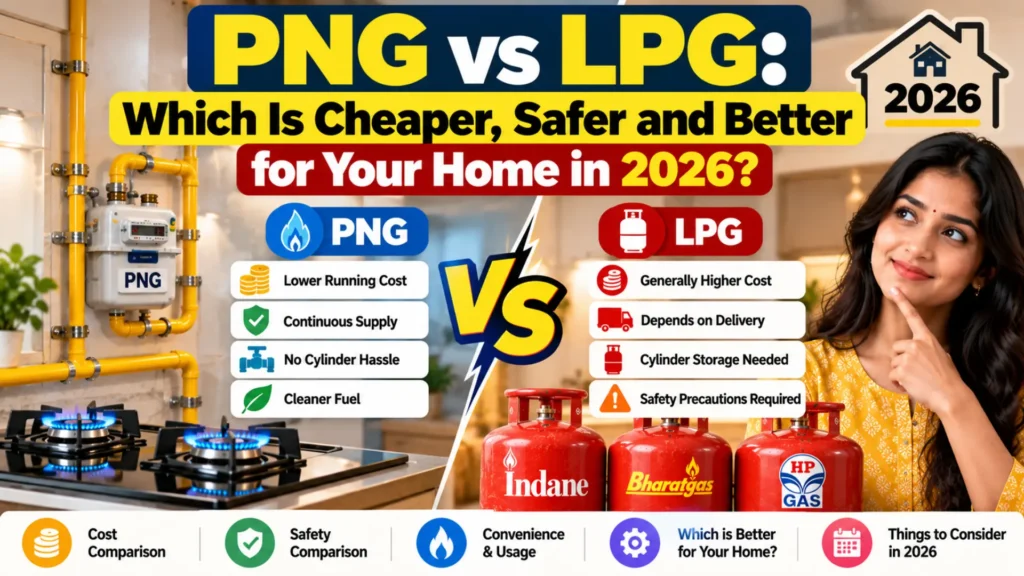
PNG vs LPG at a Glance
| LPG cylinder | PNG (piped gas) | |
|---|---|---|
| How you get it | Book a refill, wait for delivery | Comes through a pipe, 24×7 |
| How you pay | Upfront, for every cylinder | After use, through a bill |
| How it’s priced | Per cylinder | Per unit (SCM) on a meter |
| Upfront deposit | About ₹2,450 in most of India | Usually ₹6,000 to ₹7,000 |
| Gap between refills | 25 days between bookings | None |
| Storage space | Room for one or two cylinders | None |
| If gas leaks | Heavier than air, collects near the floor | Lighter than air, rises and spreads out |
| Moving house | Connection can be transferred | Stays with the address |
| Where it’s available | Almost everywhere | Only where the pipeline reaches |
| Subsidy | Regulated price; ₹300 extra for Ujjwala | No direct subsidy |
Round 1: The Monthly Cost
This is the question everyone asks first, and it’s the trickiest one, because you’re comparing a cylinder with a meter. So we need a common measure: heat.
How much piped gas equals one cylinder?
LPG packs more heat per kilo than piped natural gas does per unit. Based on typical calorific values, the gas in a full 14.2 kg cylinder gives roughly the same heat as 16 to 19 SCM of piped gas. The exact figure depends on the quality of gas your company supplies.
Gas companies have their own long-standing rule of thumb: an average family of four uses about 15 SCM a month, which is roughly the same family that goes through one cylinder a month.
So the honest range is 15 to 19 SCM for every cylinder you’d otherwise use. Let’s put rupees on it.
The Delhi example
In Delhi, a 14.2 kg cylinder costs ₹942 and IGL’s piped gas costs ₹49.59 per SCM. Here’s what the same cooking costs on PNG:
Do Read – 5 kg Gas Cylinder (Chhotu) Price
| If one cylinder equals | PNG cost in Delhi | Compared with ₹942 for LPG |
|---|---|---|
| 15 SCM | ₹744 | About ₹198 cheaper |
| 17 SCM | ₹843 | About ₹99 cheaper |
| 19 SCM | ₹942 | About the same |
So for a family that uses one cylinder a month, switching to PNG in Delhi saves somewhere between nothing and about ₹2,400 a year. Real, but not life-changing.
Other cities
Using the middle figure of 17 SCM per cylinder, here’s how a few other cities compare today:
| City | LPG (14.2 kg) | PNG rate | PNG cost for the same cooking |
|---|---|---|---|
| Noida | ₹939.50 | ₹49.46 per SCM | About ₹841 |
| Gurugram | ₹950.50 | ₹48.40 per SCM | About ₹823 |
| Kolkata | ₹968.00 | ₹50.00 per SCM | About ₹850 |
| Bengaluru | ₹944.50 | ₹53.00 per SCM | About ₹901 |
The pattern holds. PNG comes out ahead, by roughly ₹40 to ₹130 per cylinder’s worth of cooking, depending on the city.
Three things that change the math
- eKYC on your LPG connection. The ₹942 figure is the regulated price. From 1 October 2026, consumers who haven’t completed biometric Aadhaar authentication pay the market price instead, which is higher. If your LPG eKYC isn’t done, PNG looks better still.
- Ujjwala. PMUY families get ₹300 back on each of their first four refills a year. That brings a Delhi cylinder down to an effective ₹642, which no PNG rate can match. For these families, LPG is the cheaper fuel on those refills.
- PNG prices move too. In 2026, IGL raised its rates at the end of August, MGL in Mumbai raised them in May and again in September, and Torrent Gas raised Jaipur’s rate in October. MGL, for one, pointed to the rising cost of imported gas. The gap between PNG and LPG can shrink or grow after each revision.
Round 2: What It Costs to Get Started
Here, LPG is clearly cheaper.
A new LPG connection needs a refundable deposit of ₹2,200 for the cylinder and ₹250 for the regulator in most of India, so about ₹2,450 before you buy a stove.
For PNG, PNGRB’s rules cap the refundable deposit for equipment at ₹6,000 for a single connection, or ₹9,000 with a smart meter, and companies can add a gas deposit and an application fee. In practice, IGL takes ₹7,000 in all, and MGL charges ₹6,635.
Two things soften the blow. Most of the PNG amount is refundable when you disconnect. And some companies offer instalments. IGL, for example, lets you pay ₹275 upfront and the ₹7,000 deposit in 14 bi-monthly instalments of ₹500. Your existing stove is converted free of charge, so there’s no new stove to buy.
Do read – LPG Cylinder Not Delivered After Booking?
Round 3: Day-to-Day Convenience
This is where PNG pulls far ahead, and it’s the reason most families who switch never look back.
Life with LPG
- You can book only 25 days after your last refill.
- Delivery can take up to a week. IndianOil’s standard is within seven working days, subject to stock.
- Someone has to be home to receive the cylinder and share the delivery code.
- Cylinders are heavy, which matters a lot in homes with elderly parents or no lift.
- You pay the full amount upfront, every time.
Life with PNG
- No booking and no delivery. PNGRB describes the supply as 24×7 and uninterrupted.
- No cylinder taking up space in the kitchen. Nothing to store, nothing to lift.
- You pay after you use it. Under PNGRB’s rules, bills are raised at least every two months.
- You never have to guess how much gas is left. The meter tells you what you’ve used.
One small catch: some companies charge a small minimum amount even in a month you barely cook, so check the rate card if your home is often locked up.
Round 4: Safety
Neither fuel is dangerous when used properly, and crores of homes use them safely every day. But there is one real difference, and it comes down to physics.
LPG is heavier than air. If it leaks, it sinks and collects near the floor, under cabinets and in corners, where it can build up quietly.
Natural gas is lighter than air. If PNG leaks, it rises and spreads out, especially in a ventilated kitchen, so it’s less likely to collect in one spot.
There’s also no heavy cylinder full of gas sitting in your kitchen with PNG.
That doesn’t mean you can relax completely. With either fuel, close the burner knob and the gas valve after cooking. PNGRB’s own advice is to close the valve in the kitchen and call your gas company’s emergency number straight away if you ever smell gas.
Round 5: When Things Go Wrong
2026 gave both fuels a real-world test.
When the West Asia conflict disrupted supplies, LPG households faced longer booking gaps, backlogs and delivery delays for months. PNG homes didn’t have to book anything, and gas companies like MGL publicly assured customers of uninterrupted supply.
But PNG wasn’t untouched either. Its prices went up during the year, because companies buy part of their gas as imported LNG, which got costlier.
So in a crisis, PNG protects you from the queue, but not completely from the price.
Round 6: Flexibility
This round goes to LPG.
- It works almost anywhere. LPG reaches more than 33 crore connections across the country. PNG only works where a pipeline has been laid, and many smaller cities are still being connected.
- It moves with you. An LPG connection can be transferred within a city or reconnected in another one. A PNG connection belongs to the address, so moving means disconnecting and applying again at the new place.
- Renting is simpler. For PNG, tenants need the owner’s NOC or a valid rent agreement, and the owner’s building has to be connected.
The 2026 Rules You Can’t Ignore
Before you decide, know that you can’t have both. Since March 2026, a household with PNG isn’t allowed to keep a domestic LPG connection. Under a May 2026 amendment, you apply to close your LPG connection within 30 days of getting PNG, and you can take a transfer voucher to restore LPG later if you move somewhere without piped gas.
And if PNG is already available in your area, the choice may not stay yours for long. If your gas company writes to invite you to apply and you don’t, your LPG supply may stop three months after that letter.
So, Which One Should You Choose?
PNG makes sense if
- The pipeline already reaches your building or colony.
- You plan to stay at the same address for a few years.
- Your family cooks a lot, or you’re simply tired of booking and waiting.
- There are elderly people at home who shouldn’t be dealing with cylinders.
LPG makes more sense if
- There’s no pipeline in your area yet.
- You move house every year or two.
- You’re an Ujjwala beneficiary, and the ₹300 subsidy matters to your budget.
- The upfront PNG deposit isn’t affordable right now and no instalment scheme is offered.
If you’re a tenant
Talk to your landlord first. If the building is connected and the owner agrees, PNG is usually worth it, especially if you’re planning a long stay.
Do Read – How to Book a Gas Cylinder by Missed Call or Phone Call
Quick Answers
Is PNG cheaper than LPG?
In most big cities, slightly. In Delhi, the same cooking costs about ₹744 to ₹942 on PNG against ₹942 for a cylinder.
How many SCM of PNG equal one LPG cylinder?
Roughly 15 to 19 SCM, depending on gas quality and how it’s measured.
Is PNG safer than LPG?
It has an edge, because natural gas is lighter than air and spreads out if it leaks, while LPG settles near the floor. Both are safe with basic care.
Can I keep my LPG cylinder after getting PNG?
No. Under the 2026 rules, you apply to close your LPG connection within 30 days of getting PNG.
Do I need a new stove for PNG?
No. The gas company converts your existing stove free of charge.
The Pipe or the Cylinder?
If you only remember one thing, make it this: PNG is mainly about convenience, and the savings are a bonus, not the main reason to switch. If the pipeline is at your door and you’re staying put, it’s an easy upgrade. If you move often, live where pipes haven’t reached, or depend on the Ujjwala subsidy, your trusted cylinder still does the job well.
For the official details on domestic PNG connections, read PNGRB’s consumer FAQs. And if you’ve already made the switch, we’d love to hear how your first bill compared with your old cylinder.
Do Read – How to Book a Bharat Gas Cylinder

Pratham Shetty is an SEO Expert for Websites , Blogs and Apps and has been working in this field since 2020 . He has developed many Blogs and apps and one of the LPG gas booking apps crossed 25k+ Organic downloads in few Months . You can Search LPG Gas Boooking app by Classic Avenue and enjoy the app.