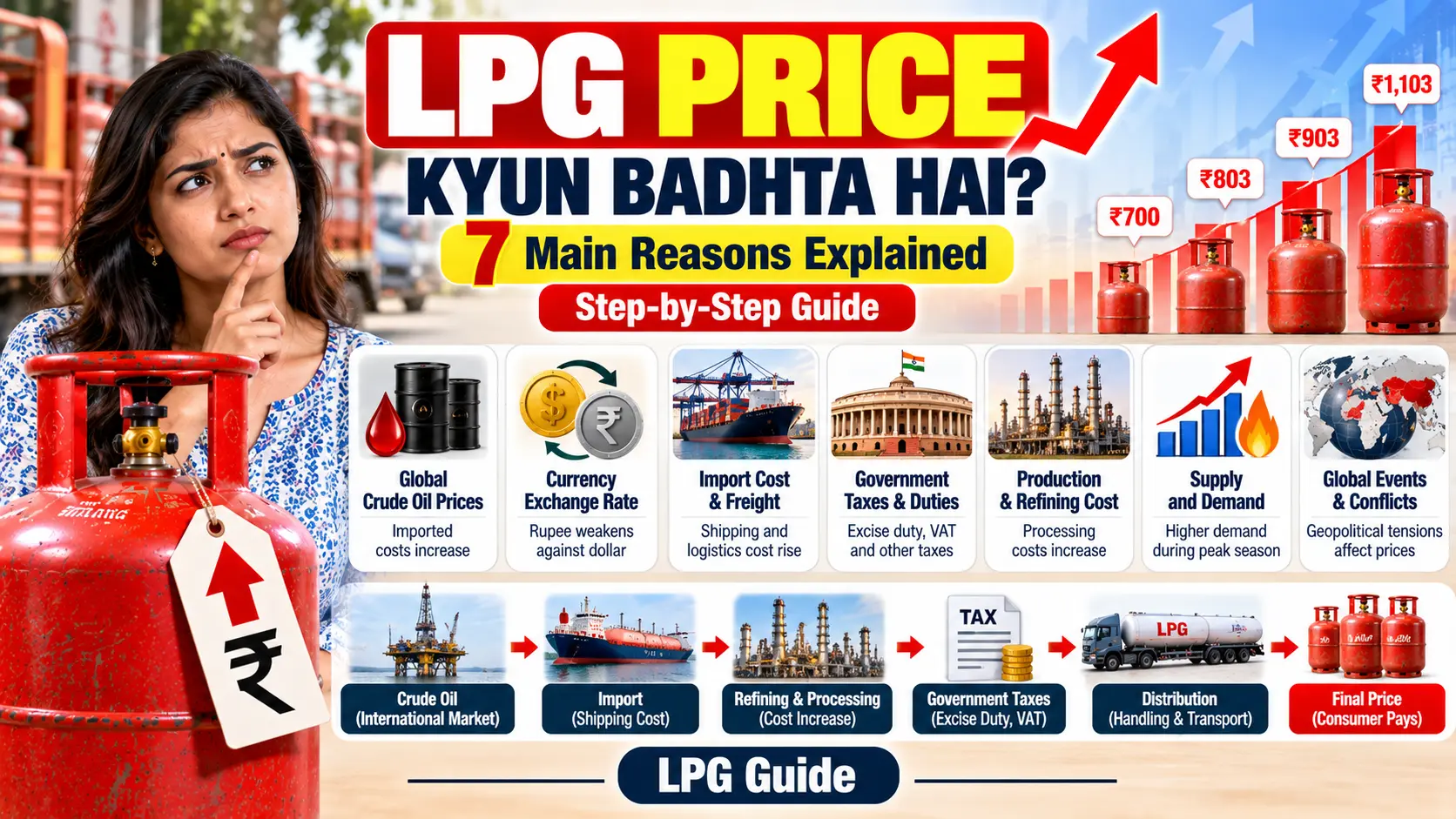
On the first of every month, the same question does the rounds on family WhatsApp groups: “Gas ka rate phir badh gaya?” Sometimes it has. Often it hasn’t. And sometimes the price changes on the seventh instead, which confuses everyone even more.
The price of your cylinder isn’t random, and it isn’t set by your distributor. It comes out of a fairly simple formula that starts in Saudi Arabia, passes through the dollar-rupee exchange rate, and ends with a decision about how much of the cost the government and oil companies will absorb. Once you see how that chain works, the monthly changes start to make sense.
Where India’s LPG Comes From
India imports around 60 per cent of the LPG it uses, and about 90 per cent of those imports pass through the Strait of Hormuz, the narrow sea route out of the Persian Gulf. Both figures come from the government’s reply in the Rajya Sabha in March 2026.
That single fact explains most of what happens to your gas bill. When most of your LPG is bought abroad and paid for in dollars, the price you pay at home has to follow what’s happening in the international market.
The Benchmark: Saudi Contract Price
According to the Ministry of Petroleum and Natural Gas, LPG prices in India are based on the Saudi Contract Price (Saudi CP), which is the main benchmark for international LPG prices. Saudi Aramco announces it every month, in US dollars per tonne.
The government has also explained that the LPG price here is derived from the international market price for the previous month. So a jump in the benchmark this month shows up in your price at the next revision.
How the Price of Your Cylinder Is Built
In a written reply to Parliament in 2026, the government listed the parts that make up the LPG price:
- The international benchmark price, the Saudi CP
- The currency exchange rate, to turn dollars into rupees
- Ocean freight, to ship the gas to India
- Inland transportation, from the import terminal or refinery to the bottling plant and on to your distributor
- Bottling costs, for filling and checking cylinders
- Distribution margins
- Marketing margins
On top of this comes GST: 5 per cent on domestic LPG and 18 per cent on commercial LPG.
How much goes to your distributor
One piece of the price is fixed and easy to see. The commission your distributor earns on a 14.2 kg domestic cylinder is ₹73.08, according to the government’s Petroleum Planning and Analysis Cell (PPAC). It has stayed at that level since October 2023. That covers the distributor’s running costs, including bringing the cylinder to your door.
So out of the ₹942 you pay in Delhi today, about ₹73 goes to the agency. The rest is gas, freight, bottling, the oil company’s costs and tax.
Why the Dollar Matters as Much as the Gas
The Saudi benchmark is priced in dollars. When the rupee weakens against the dollar, the same tonne of LPG costs more in rupees, even if the benchmark hasn’t moved at all.
The reverse is true too. A stronger rupee can soften the blow of a rise in international prices.
For a sense of scale, here’s an official example. In January 2020, the international LPG price rose from $448 to $567 a tonne, and the government said this pushed up the Delhi price of a 14.2 kg cylinder by ₹144.50 in a single revision.
Why Your Cylinder Doesn’t Move Like a Restaurant’s
If you’ve followed the news this year, you’ll have noticed that commercial cylinders swung wildly while household cylinders barely moved. That isn’t an accident.
The ministry says that for domestic LPG, the government “continues to modulate the effective price to consumer to insulate the common man from rise in international prices.” In plain words, household gas is deliberately kept below its full cost.
The oil companies absorb the difference, which is called under-recovery. The gap is real money. On 1 January 2026, the government said a 14.2 kg cylinder costing around ₹950 was being sold at ₹853 in Delhi. The government later compensates the companies for part of this: ₹22,000 crore for 2022-23, and another ₹30,000 crore approved for 2025-26.
Commercial LPG gets no such cushion. It’s priced much closer to its actual market cost, so every swing in the Saudi benchmark passes through almost fully.
2026 in Numbers
This year shows the difference clearly. Here’s the Delhi price at the end of each month:
| Month (2026) | 14.2 kg domestic | 19 kg commercial |
|---|---|---|
| February | ₹853 | ₹1,740.50 |
| March | ₹913 | ₹1,883 |
| April | ₹913 | ₹2,078.50 |
| May | ₹913 | ₹3,071.50 |
| June | ₹942 | ₹3,113.50 |
| July | ₹942 | ₹2,930 |
| August | ₹942 | ₹2,738 |
| September | ₹942 | ₹2,747.50 |
Across these months, the household cylinder went up twice: by ₹60 on 7 March and by ₹29 on 7 June. That’s ₹89 in all, roughly 10 per cent. The commercial cylinder, meanwhile, went up by ₹1,373 between February and June, including a single jump of ₹993 on 1 May, and then fell back by about ₹375 over July and August.
The trigger was the conflict in West Asia and the disruption around the Strait of Hormuz. The Saudi benchmark had already risen about 41 per cent between July 2023 and February 2026, from $385 to $542 a tonne, and it climbed further in the months that followed.
Even after the two domestic hikes, household gas stayed well below cost. The government put the gap at more than ₹500 per cylinder in July and about ₹210 in September. By the end of August 2026, the oil companies’ accumulated under-recoveries had crossed ₹62,000 crore.
Why Your City’s Rate Is Different From Delhi’s
The GST rate on LPG is the same everywhere. What differs is mainly the cost of getting the cylinder to you, along with some local levies.
A city far from import terminals and bottling plants pays more freight on every cylinder, and that shows up in the final price. That’s why, for the same 14.2 kg cylinder today, Noida pays ₹939.50, Delhi ₹942, Kolkata ₹968 and Hyderabad ₹994.
When Do Prices Change?
Revisions usually happen on the 1st of the month, and that’s when commercial prices change almost every time.
Domestic prices are different. They can stay unchanged for months, and when they do move, it isn’t always on the 1st. Both household price rises in 2026 came on the 7th of the month, in March and June. So if you hear a rumour on the 1st, check before you believe it, and if nothing changed on the 1st, don’t assume nothing will change that month.
Can You Predict the Next Change?
For commercial cylinders, roughly. If you see news of international LPG or crude prices rising sharply, or the rupee weakening, expect the next revision to go up.
For household cylinders, not really. Because the government decides how much of the rise to pass on, domestic price changes are as much a policy decision as a market one. The best you can do is check the rate after each revision.
One thing you can control: from 1 October 2026, the regulated price applies only to consumers who have completed biometric Aadhaar authentication (eKYC). Without it, you pay the market price. If you haven’t done it yet, that will affect your bill more than any monthly revision.
Quick Answers
Who decides the LPG price?
The public sector oil marketing companies set it, based on the Saudi Contract Price. For domestic LPG, the government also decides how much of any rise is passed on to households.
Why did commercial LPG get cheaper in July and August while domestic didn’t?
Commercial prices follow the market both ways. Domestic prices had been held below cost during the rise, so there was no room to cut them when international prices eased.
Is LPG in India linked to crude oil prices?
Indirectly. The benchmark is the Saudi Contract Price for LPG itself, which tends to move with the wider energy market.
How much of my cylinder’s price is tax?
GST is 5 per cent on domestic LPG and 18 per cent on commercial LPG.
Does the distributor decide the price?
No. The distributor gets a fixed commission, ₹73.08 on a 14.2 kg cylinder. The price is set by the oil companies, and a distributor can’t charge more than it.
So, Why Does It Change?
Because most of our LPG is bought abroad at a price set in Saudi Arabia, paid for in dollars, and shipped through one of the world’s most sensitive sea routes. The only reason your household cylinder doesn’t swing the way a restaurant’s does is that the government and oil companies choose to absorb much of the difference. When that cushion gets too expensive, the domestic price goes up too.
The ministry’s own explanation of how product prices are set is on its product pricing page. And if there’s a price change you’d like explained, write in and we’ll try.

Pratham Shetty is an SEO Expert for Websites , Blogs and Apps and has been working in this field since 2020 . He has developed many Blogs and apps and one of the LPG gas booking apps crossed 25k+ Organic downloads in few Months . You can Search LPG Gas Boooking app by Classic Avenue and enjoy the app.